CEW Lab
Clean Energy and Water Laboratory · Department of Mechanical Engineering · Kate Gleason College of Engineering · Rochester Institute of Technology

Materials set what a cell could store. Mechanics decides how long it survives storing it.
The Clean Energy and Water Laboratory studies how solids deform while they react — the coupling that limits solid-state batteries and separation membranes — at RIT's Kate Gleason College of Engineering.
A battery is a structure that changes shape while it works. Lithium plates into a ceramic that cannot accommodate it, cathode particles swell and crack away from their conductive network, and a separator that was mechanically sound at assembly is fractured after fifty cycles.
In ionic ceramics, electrodes, and ion-gated microelectronics, microstructure and properties evolve while the device operates — so the processing–structure–property relation never closes. We ask what stress does to a material reaction when the constitutive response is itself a state variable, and how the competition between mechanics and electrochemistry decides performance.
We call that question reactive mechanics, and we pursue it by modeling and by experiment — then apply it across energy storage, chip-scale microelectronics, and environmental separation and critical-element recovery.
Research thrusts
-
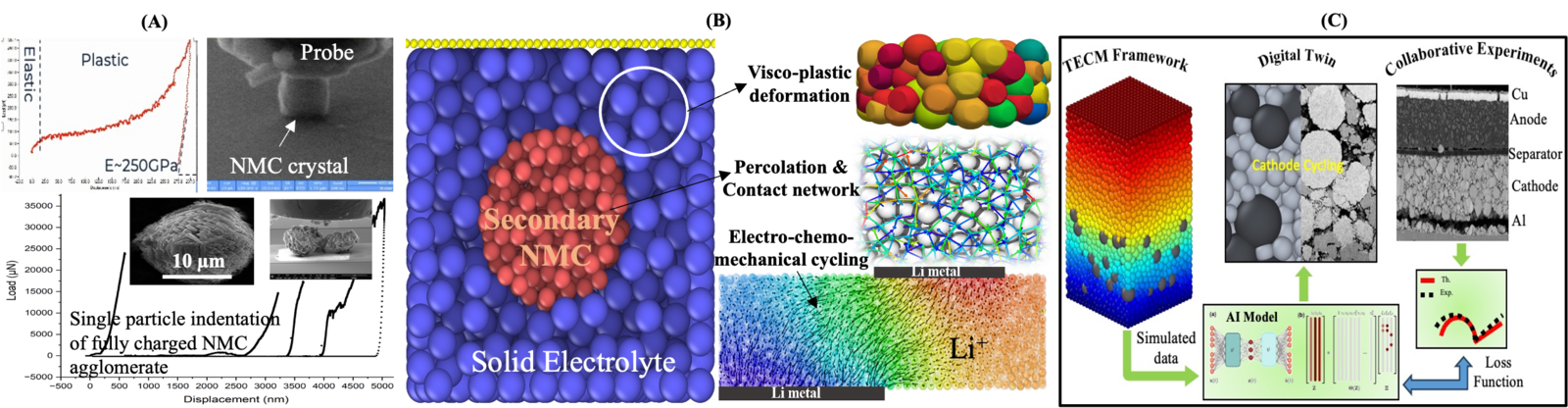
Reactive mechanics
One constitutive law for a reacting solid: stress feeding back into reaction rate, granular creep during densification, and a thermo-electro-chemo-mechanical framework with an AI surrogate.
Read more → -
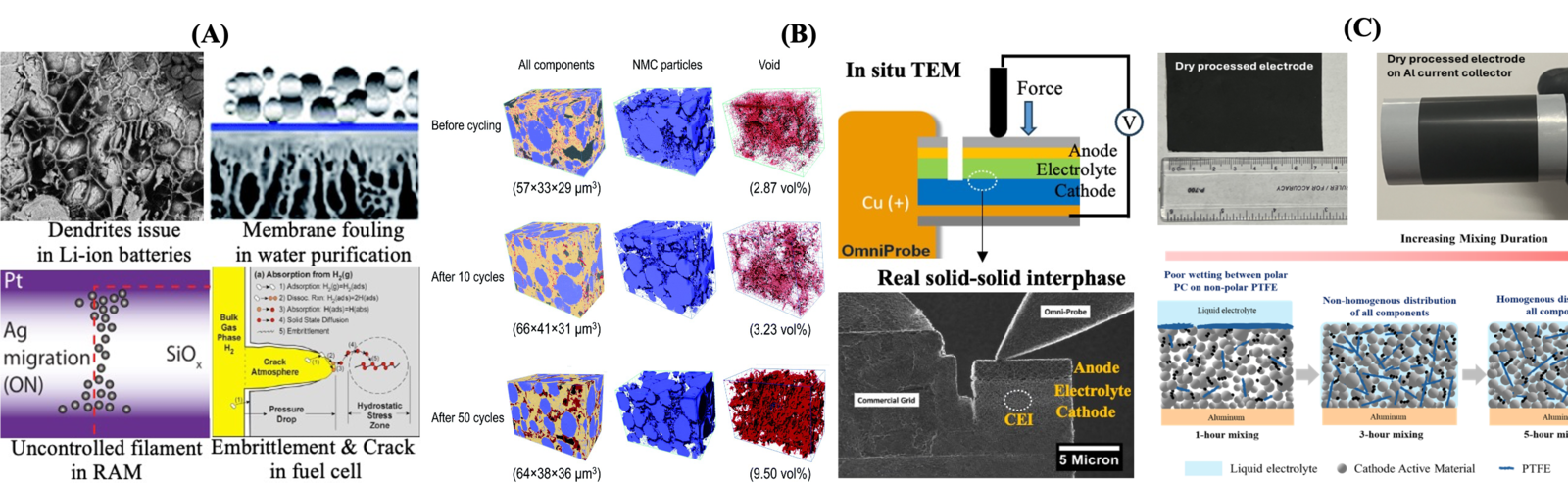
Energy storage
Solid-state cells fail mechanically before they fail electrochemically. Dendrite fracture, composite-cathode accommodation, and dry-processed scale-up.
Read more → -
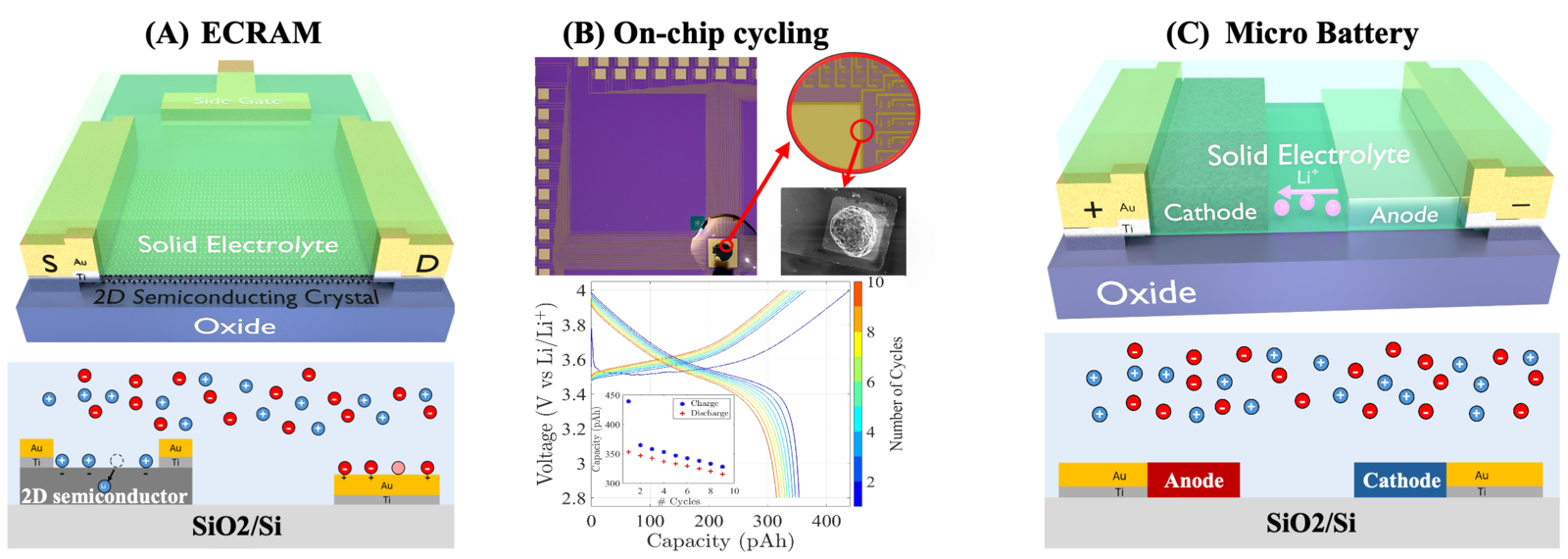
Microelectronics
Electrochemistry on the chip: ECRAM for neuromorphic computing, single-particle measurement at picoamp-hour resolution, and lithographically defined micro-batteries.
Read more → -
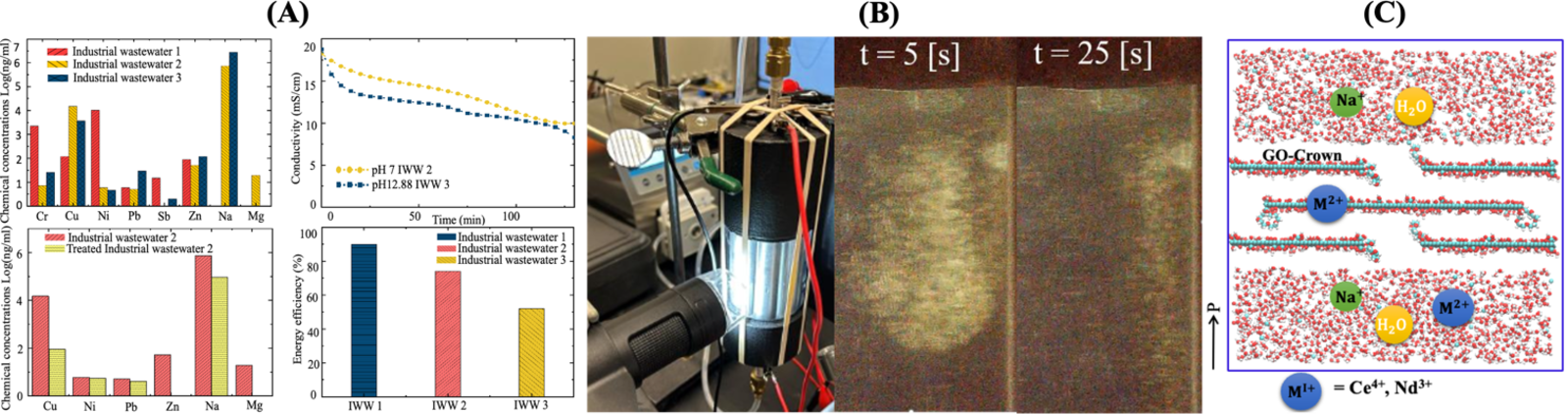
Separation & recovery
Electro-reactive deionization for industrial wastewater, membrane-free separation with aqueous ion traps, and closed-loop recovery of rare earths.
Read more →
We are hiring
The CEW Lab has openings for MS and PhD students and postdoctoral researchers in both research directions. Experience with electrochemistry is welcome but not required to start — we look for a background in solid or fluid mechanics and in continuum or atomic-scale modeling.
See openingsnews
| Jul 15, 2026 | The lab receives an NSF Energy Storage Engine award for ROC-BEAT (Rochester Battery Engineering and Training), a nine-institution regional battery workforce consortium. Prof. Tu leads the university tier. |
|---|---|
| Jul 09, 2026 | Invited talk at the U.S. Army Research Office, Research Triangle Park, NC: A General Framework for the Dendrite Issue in Mono/Multi-Valent Solid-State Batteries. |
| Jun 01, 2026 | NSF DMR–Ceramics funds Understanding the Granular Creeping Behavior during the Densification Processing of Ceramic Electrolytes in All-Solid-State Batteries — a four-year award seeded directly by the lab’s own granular-creep result. |
| May 01, 2026 | New paper in Nano Letters. Bage et al. show that lithium dendrites can be suppressed by making the electrolyte mechanically anisotropic, detouring Li transport rather than blocking it. Four of the six authors are CEW Lab trainees. |
| Apr 28, 2026 | Invited seminar at UC Davis, Mechanical & Aerospace Engineering. |
selected publications
- Understanding metal propagation in solid electrolytes due to mixed ionic-electronic conductionMatter, 2021
- Effect of solid-electrolyte pellet density on failure of solid-state batteriesNature Communications, 2024
- Dendrite suppression by detouring Li transport within a mechanically anisotropic solid electrolyteNano Letters, 2026
- Granular creep and its role in optimizing solid electrolyte fabrication for all-solid-state batteriesSmall Methods, 2026
- Self-sacrifice of sulfide electrolytes facilitating stable solid-state sodium–sulfur batteriesEnergy & Environmental Science, 2025